
Level 1 Charging – Can and Should aren’t the same thing…
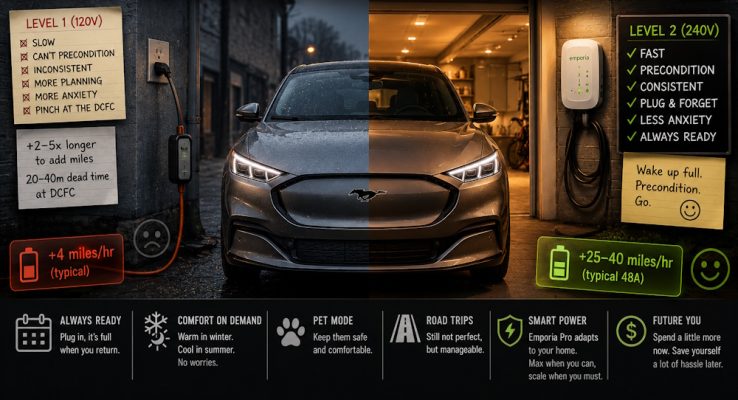
Every now and again I run across some EV evangelist pushing the narrative that Level 1 (120V) charging is plenty fine, good enough, blah blah blah. OK, so, they are kind of right but not in the way that makes the EV experience “better” than what most people would experience with an ICE vehicle.
I wouldn’t tell an EV curious person to use Level 1. Can you do it? Sure. Would I do it? Nope. Have I tried it? Yep… It made it a chore to manage miles and make sure I plugged in the car. “That sounds like a hassle” is a legit response to that suggestion.
Also, if you’re going to go through the trouble of having a EV circuit pulled, hardwire it, if you can’t put in 60A use a Emporia Pro. In many areas labor is a major part of the cost. The difference in materials and a couple hundred $ on the EVSE is negligible over the lifetime of use. Your future self will thank you.
I completely agree that for most folks, with most EV, you can make it work – I mentioned that initially. We agree there.
But “can” and “should” aren’t the same standard. Being able to make something work isn’t a compelling lever for someone who is coming from a place where they have a solved problem. ICE transportation is very much a solved problem. You don’t have to do math or worry about “what happens in an emergency and I need to drive 200 miles today”, you can just do that. L1 charging can work, but there are trade-offs – a lot of trade-offs.
For the most part EV are better cars. They just are. Part of what makes them better is the convenience around not needing to worry about fueling 90% of the time. You plug it in, it’s always “full” when you come back. Before a road trip, you move the “full” marker from 80% to 100%. On a cold day, you press a button on your phone and get into a warm car where most of the snow and ice has already melted off. On a hot day, you can press a button and cool the car down. There are no concerns about doing that in an enclosed space. You can keep the HVAC on for your pet while you step away from the car. Those are all awesome things.
There are some inconveniences though. Or, actually just one if you do it right. Traveling between cities has more friction than ICE. There are fewer DCFC stations than gas stations. It takes longer to refuel – some cars are only 2x an ICE car, most of them are in the 3-5x range. This isn’t a big deal in most situations, but it is a thing that we need to acknowledge.
There are also different standards of planning. You can plan for the minimum viable, average, or peak. L1 is a minimum viable strategy. You don’t need to be a lunatic to understand that minimum viable isn’t a workable strategy for most people. It’s a strategy for people who are bad at risk and zealots.
Most of the fueling conveniences that don’t involve long-distance travel, go away when you L1 on most EV. You can’t go from whatever SOC you rolled in with last night to 100% overnight. You can’t precondition the car. You can’t precondition the battery before a cold road trip – this destroys your range. This is why I think it’s somewhat disingenuous (even though I know why we do it) to use “miles of range” when talking about kW delivered or kWh. m/kW at 60F and m/kW at -10F are very different. A “just do the math” approach might change a “can work” in the summer to a “LOLL, nope” situation in the winter… You do get to dramatically reduce your reliance on external fueling sources, but in those “pinch” moments you’re taking on friction, the really annoying spend-a-while-at-a-DCFC friction, at the worst times. How much of an impact that 20-40m of dead time once you get to the DCFC might not matter very much, it might matter a lot.
L2, even low level L2, fixes that for most vehicles. That is also math. If it takes 7kW to heat the car and precondition the battery (like it does on a Ford MME), you aren’t doing that on a 15A circuit.
Even if your panel is limited, solutions like the Emporia Pro can dynamically scale available current, so most of the time you can take full advantage (48A), when other things are demanding current, it can dial it back (all the way to off, IIRC) to keep under your service limit. The difference in cost between that and a quality fixed level EVSE is a couple hundred $.