
Comparing Heat Pump Apples and Tomatoes
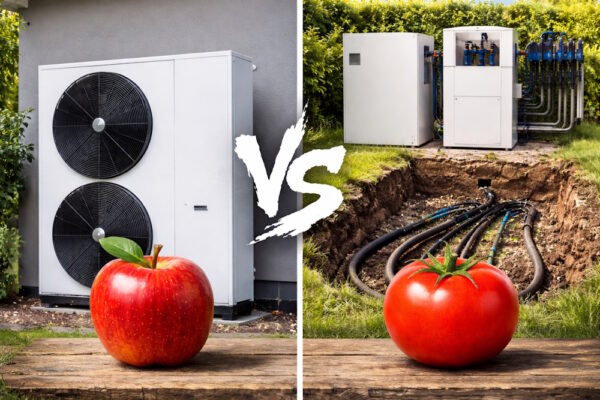
Matt really likes his ground source heat pump (GSHP). TBF, if I had one, I would probably be trying to keep making it look good too. This isn’t the first time Matt has brought up the ASHP (air source heat pump) comparison, but it is the first time he’s done it with “real” data comparing his house + HP and another person’s house + HP. It’s neat, but if the intent is in anyway intended to make a data driven argument, it fails pretty hard. Some of which is kind of disingenuous.
I suspect that Matt was trying to make a data driven point, which is why I’m bothering with this post. He misses enough things that I found the self-delivered-pat-on-the-back annoying. Before digging into some of the less obvious issues with the comparison, let’s cover the disingenuous one…
The 30% federal tax credit that Matt used to dramatically lower the cost of his system isn’t available anymore. So anyone who is evaluating GSHP v ASHP today, won’t be able to get that. It’s awesome that he got it. IMO, getting it doesn’t fundamentally change the math for most people; still really tough to ROI even with it. Now that it’s gone… He should have mentioned that. He didn’t. He knows, he’s mentioned it before… Any discussion on this topic needs real data, real numbers, to be useful.
The tax credit disappearing has broader implications as well. GSHP is a low volume product. Only ~50,000 were installed in the US in 2024 (I couldn’t get 2025 numbers). In comparison, 2025 saw 3,600,000 ASHP installed in the US. In 2024, 4,120,000 were installed. It is too early to say how large an impact removing the 30% tax credit will have on GSHP sales, but it’s very difficult to see how it won’t move a difficult to ROI product into an almost impossible sales position. Lowering sales volume will make finding installers and service techs more difficult. It will reduces economies of scale. Dry up further innovation in the space. Potentially even kill it as a viable product. That’s why it’s important to look past the short term victory lap…
Now let’s dig into the victory lap…
Matt compares his almost-Passive House (i.e. built to something close to the Passive House spec, but did not go through the certification process) new construction to a refurbished house from the 1990s. The owner of the 1990s house did a lot of work on it, but it simple cannot compete. It’s an apples to tomatoes comparison. Sure, they might look similar, but once you get under the skin…
Some of this might not be obvious, I certainly didn’t understand the nuance here until really digging into the topic when we started building our Passive House. There are different approaches to solving the sealing/insulation problem. I don’t know what Matt went with, but it doesn’t really matter because what matters is that you hit your sealing/insulation numbers. That he designed around those numbers, is a massive thumb on the scale even compared to a new house, let alone something built in the ’90s.
I can speak to how we’re doing it…
The outside of the house (b/w the siding and plywood) was covered in a product called Sto Gold. This creates an air and moisture seal. Think about it like we dipped the house in rubber cement. All of the pores get saturated with it when they paint it on.
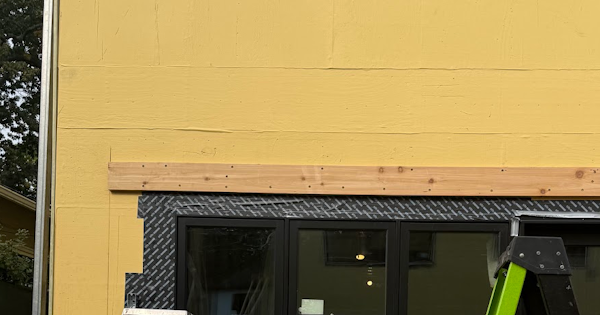
We opted for a two-wall design. This shows the 6″ exterior wall covered with a vapor barrier. There is 6″ of insulation b/w the plywood and the white sheet you see here.
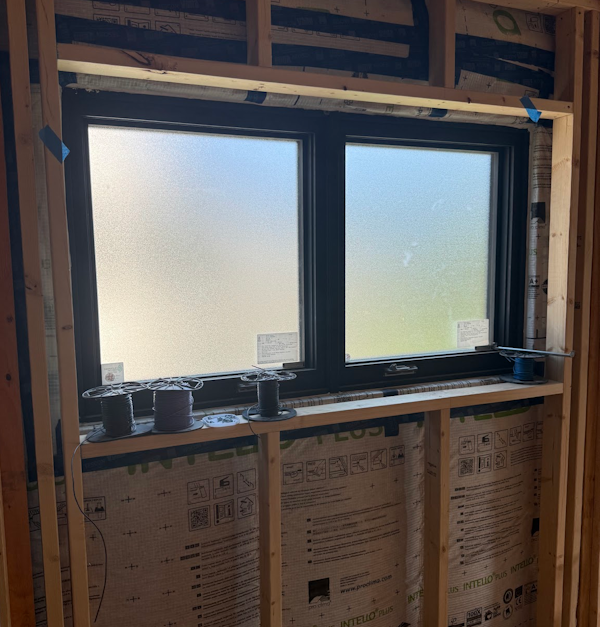
Inside of that wall, there is another 4″ wall installed 1″ off the 6″ exterior wall. All of the plumbing, electrical, etc goes through this wall. This creates an air gap b/w the two walls and ensures that the 6″ primary insulation is not compromised by any pipes. It also ensures that there is no thermal bridging b/w the outside temp and the inside temp. Then that 4″ wall was insulated (what you see below).
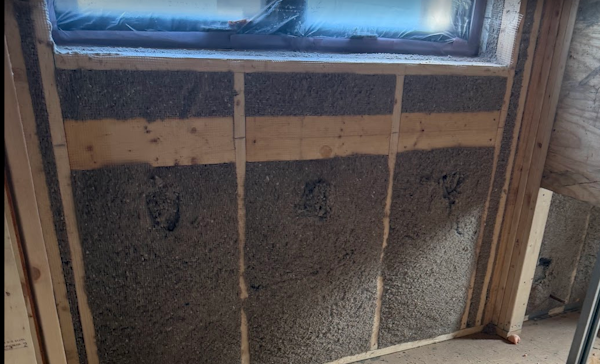
Comparing the thermal efficiency of that design to a standard house, even a house refurbished to a very high standard, is bonkers… Matt does that with a hand wave about how his R-values would be better.
There wasn’t a ton of detail on the other guy’s ASHP install, besides a few comments about how it was installed wrong. He’s had to do a bunch of work to fix that, and that work is incomplete.
What I can see in the video is that he went with a Bosch ASHP setup. Clearly those work, but they don’t have the same level of efficiency, especially in cold weather, compared to other vendors like Mitsubishi. Some quick back of the envelop Chat GPT math indicates that the efficiency gap in Connecticut (cold weather performance hurts the most) b/w Bosch and Mitsubishi HyperHeat is b/w 10-30%…
There were some valid points in the video however. Most notably, how important it is to decouple your ERV from the standard duct work. You need to be able to operate these systems independently. They do different things. It really hampers the ability of the system to manage the V[entilation] aspect of HVAC.